
A couple of months ago, I spoke with an Indian Residential School Survivor. We were discussing the impending destruction of the largest archive of Survivor testimony from the Independent Assessment Process (IAP).
He was one of the more than 38,000 Survivors who participated in the IAP in order to receive compensation for abuse in Indian Residential Schools. The fate of their IAP records - including applications, transcripts, audio recordings and decisions - were at the centre of a Supreme Court of Canada court case in 2017. The Supreme Court ruled that Survivor records from the IAP should be destroyed unless Survivors decided to opt-in to preserve them.
The Survivor told me that he didn’t remember if he had gotten a letter or email about his options following the Supreme Court decision. He knew that his records were set for destruction unless he chose to preserve them by the September 2027 deadline but said that he wasn’t sure what the process was.
It made me wonder exactly what the notice program consisted of and how it was informing Survivors about their rights.

This summer, our team at the Indian Residential School Records Project, spent weeks scanning more than 70 boxes of documents relating to litigation of Indian Residential Schools. Since then we have been combing through them, uncovering the story of the battle over the IAP records and how the notice program would roll out.
After reading through the documents, I understood why the Survivor I spoke to couldn’t recall if he had gotten a letter or email about his options for IAP records – it was because he was never sent one.
In fact, only 34 Survivors received letters about their IAP records.
A ‘robust’ notice program
Following the Supreme Court decision, the notice program was administered by Daniel Shapiro, Chief Adjudicator of the IAP. It was meant to reach out to Survivors who participated in the IAP to inform them of their options regarding their records before the destruction deadline of September 19, 2027.
Survivors could choose to do nothing and their records would be destroyed. They could also request a copy of their records to keep for themselves and/or they could have their records sent to the National Centre for Truth and Reconciliation (NCTR) to be preserved. Survivors who sent their records to the NCTR could choose if they wanted them to be redacted to protect their privacy.
In 2018, Ontario Superior Court Justice Paul Perell wrote that “the notice program must be sufficiently robust to allow for IAP claimants to make informed choices about what should happen to their records.” However, only the 34 Survivors who resided outside of Canada were sent letters directly informing them of their rights. Survivors in Canada were not contacted by letter or email due to concerns about privacy and confidentiality.
The Chief Adjudicator of the IAP consulted psychologist Ingrid Söchting who cautioned that a notice program could be harmful for Survivors. She wrote, “All remain vulnerable to various extents to becoming re-traumatized either through reminders of what they endured or through aspects of the Notice Program that may trigger and evoke old feelings of mistrust of institutions, persons in authority, along with a feeling of being coerced, having one’s autonomy undermined, and not valued for one’s intrinsic worth.”
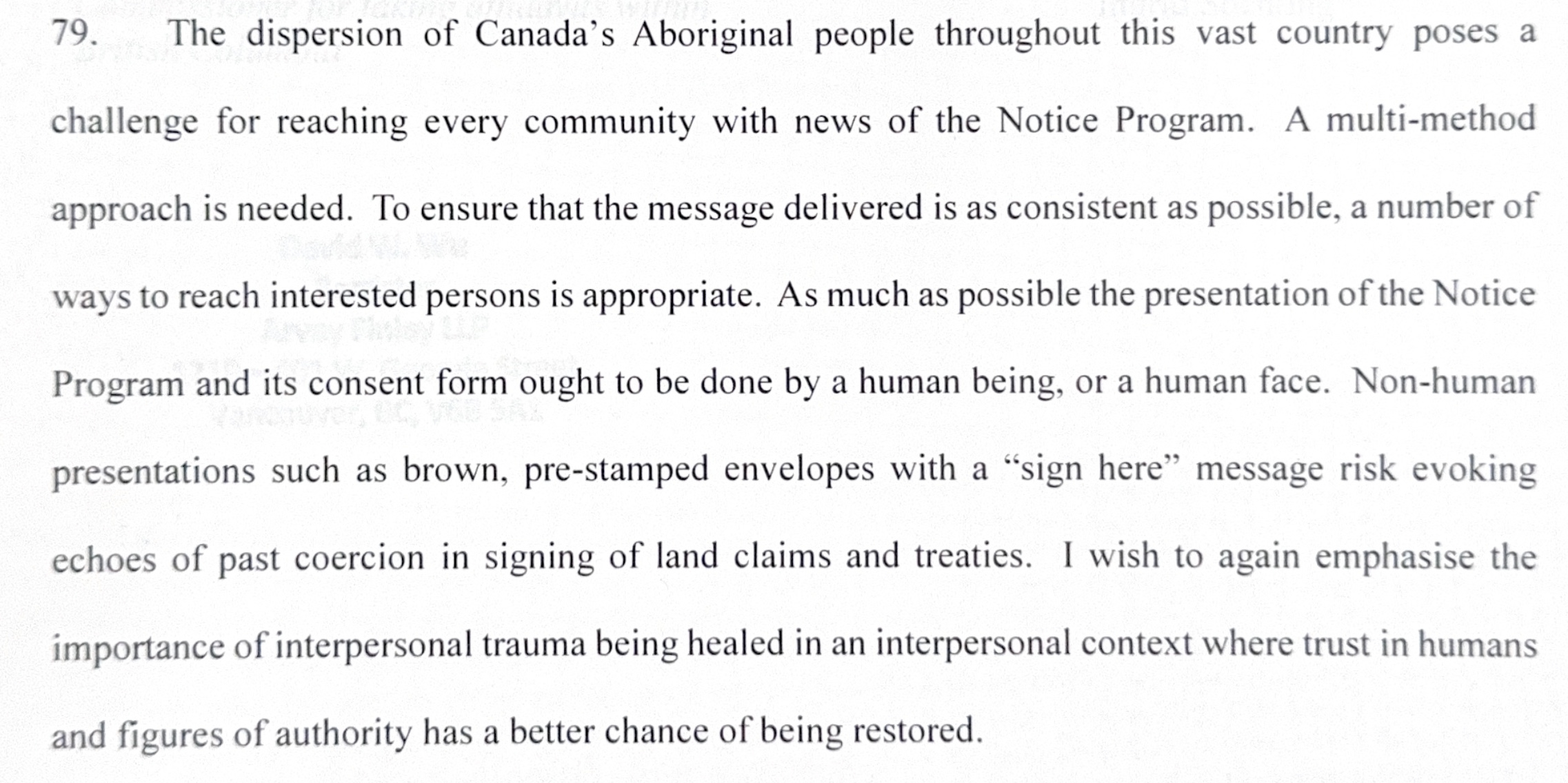
Söchting recommended that Survivors be given information about the notice program in person and warned about sending a letter in the mail. “As much as possible the presentation of the Notice Program and its consent form ought to be done by a human being, or a human face. Non-human presentations such as brown, pre-stamped envelopes with a “sign here” message risk evoking echoes of past coercion in signing of land claims and treaties.”
Initially, the notice program included plans to host more than 50 community gatherings across the country to engage directly with IAP claimants that included support from Resolution Health Support Workers. Later, those plans were scrapped over concerns regarding confidentiality and cost effectiveness. Justice Perell said hosting community meetings “doesn’t strike me as a valuable or necessary component of the notice plan.”
Notice program largely consisted of TV and radio ads that ran for 4 weeks in 2019
Instead, the program largely relied on a multi-media campaign that ran over four months from January to April 2019. The campaign included ads on APTN, CBC North and 11 Indigenous radio networks that were to air over a four week period, a single notice to run in five mainstream newspapers, 40 full-page notices in over 30 Indigenous print publications and ads on several websites.
At the same time, the Phase 2 of the notice program mailed out information packages to 1,200 organizations including band offices, friendship centres, tribal councils, and correctional institutions. Each package contained a USB stick with posters and pamphlets and a DVD with videos produced by the IAP Secretariat.

Phase 3 of the notice program outlined targeted outreach to local media in Indigenous languages between April 2019 - December 2020. Phase 4 of the notice program is the website, “My Records, My Choice” which remains active but has not been updated since 2019. The website links to social media accounts on Facebook, Instagram, X (formerly Twitter, and YouTube. All have been inactive since 2020 or 2021.

Success of notice program ‘cannot be measured’ by engagement
In 2021, after the first three phases of the notice program were complete, a progress report from the legal services company managing the IAP records shows that zero Survivors chose to preserve their records at the NCTR and only 4 submitted a valid request form to obtain their records for themselves.
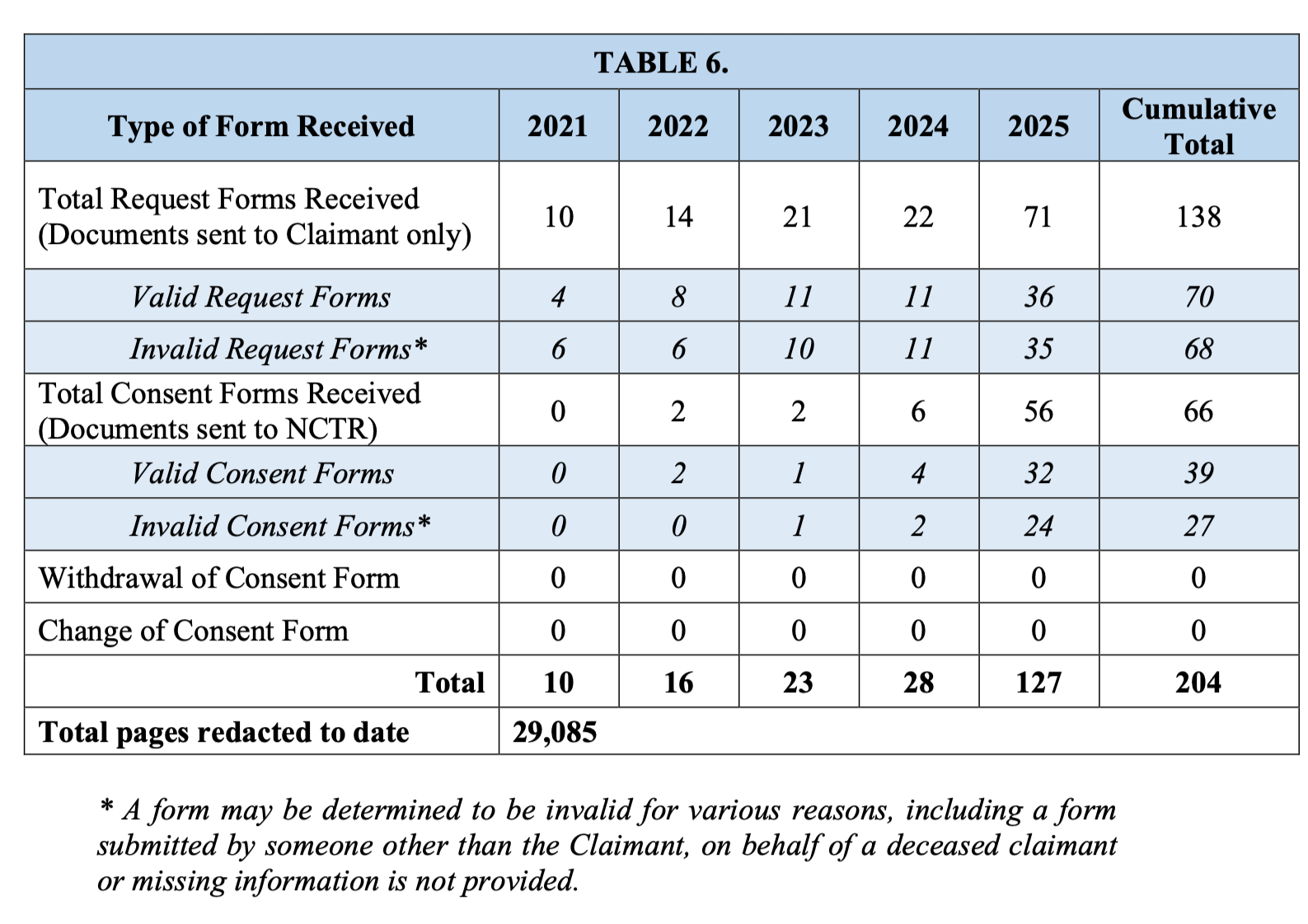
The numbers go up incrementally over the years. Last year, the largest number of Survivors chose to preserve their records - 32 were sent to the NCTR and 36 were sent to Survivors directly. Only Survivors can access their records, their family members cannot request their records on their behalf.
In total, 109 Survivors have opted in to preserve their records since 2021.
The progress report also notes that there are several provinces and territories (New Brunswick, Newfoundland, Yukon and Nunavut) from which no claimant inquiries were received. The report states “outreach and awareness in these areas may need to be enhanced”.
It’s unclear whether the low engagement from Survivors is because they don’t want to preserve their records or because they were not informed of their options. Either way, it might not matter to the court. In Justice Perell’s order, it says: “Due to the fact that claimants can make a choice by doing nothing, the success of the notice program cannot be measured on how many claimants ask for a copy of their records or request to archive their record.”

Responding to questions about the low engagement of Survivors to the notice program, Crown-Indigenous Relations and Northern Affairs Canada (CIRNAC) says they are planning another public notice process in the coming weeks to ensure that Survivors are aware of their options.
Connie, I want to share this at American Indian Adoptees website. OK?
Our governments seem to put all of their energy into making plans and rules while totally ignoring follow through...